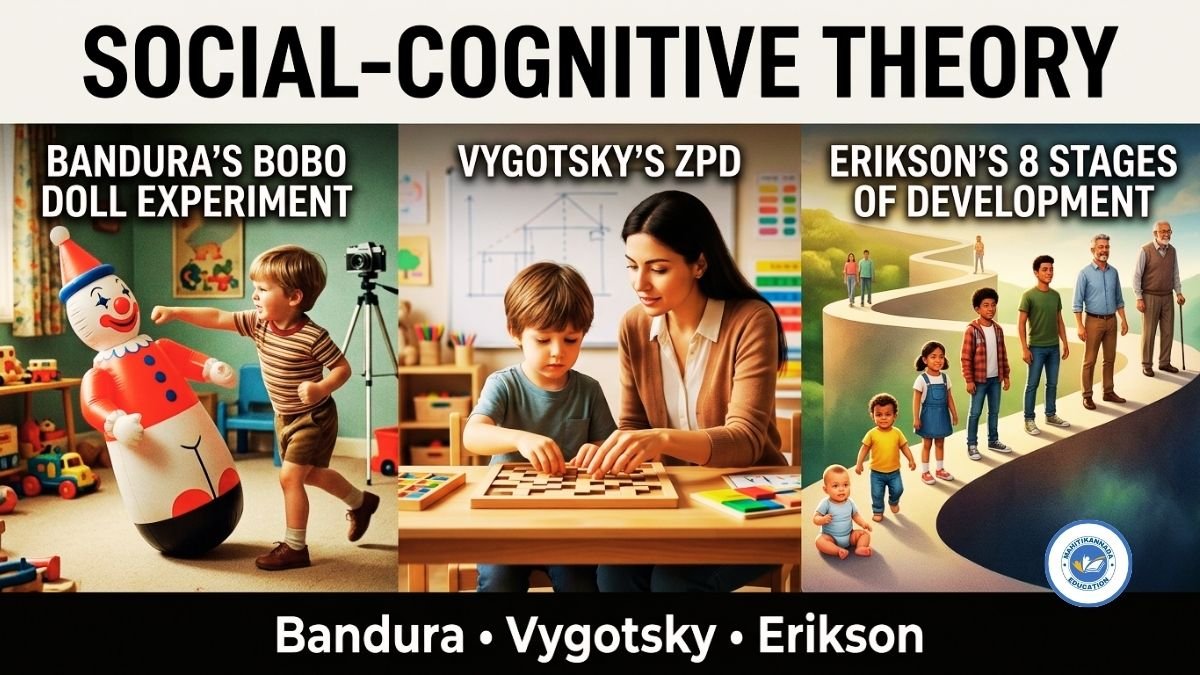
Social-Cognitive Theory: Bandura’s Bobo Doll Experiment, Vygotsky’s ZPD & Erikson’s 8 Stages of Development
Social-Cognitive Theory: Learn about Social-Cognitive Theory 2026, Albert Bandura’s Bobo Doll Experiment, the four stages of observational learning, Vygotsky’s ZPD theory, and Erikson’s eight stages of psychosocial development. Useful for TET, CTET, B.Ed, D.El.Ed, and Educational Psychology exams.
Social-Cognitive Theory 2026 in English: What is Social-Cognitive Theory? This article provides comprehensive information about Albert Bandura’s observational learning, the Bobo Doll Experiment, Vygotsky’s Sociocultural Theory, Erik Erikson’s eight stages of psychosocial development, and their educational significance.
Educational Psychology is an important subject in teacher recruitment examinations. Questions related to children’s learning, cognitive development, social development, personality development, and learning theories are frequently asked in TET, CTET, and other teacher eligibility examinations.
How do children learn? What kinds of behaviours do they acquire by observing others? How does the social environment influence a child’s intelligence and personality? How does an individual’s social and emotional development progress through different stages of life?
The theories of three prominent psychologists—Albert Bandura, Lev Vygotsky, and Erik Erikson—are particularly useful for understanding these questions.
This article explains the theories of these three psychologists in simple English, with examples and an examination-oriented approach.
Table of Contents
Meaning of Social-Cognitive Theory
Introduction to Albert Bandura
Bandura’s Bobo Doll Experiment
Four Stages of Observational Learning
Characteristics of Social-Cognitive Theory
Educational Importance of Social-Cognitive Theory
Vygotsky’s Sociocultural Theory
Role of the Social Environment in Cognitive Development
Influence of Language and Culture
Erik Erikson’s Theory of Psychosocial Development
Eight Stages of Psychosocial Development
Educational Implications for Teachers and Parents
Comparison of Bandura’s, Vygotsky’s, and Erikson’s Theories
Important Points for TET and CTET Examinations
Frequently Asked Questions (FAQs)
1. What Is Social-Cognitive Theory?
Social-Cognitive Theory is a learning theory that explains how social environments, observation of other people’s behaviour, personal thoughts, expectations, and motivation influence an individual’s learning and behavioural development.
The principal proponent of this theory was Albert Bandura.
According to Bandura, learning does not occur only through direct experience. Individuals can also acquire various behaviours and skills by observing the actions of others.
For example, a child observes a teacher speaking respectfully to others. The child may subsequently begin speaking respectfully to classmates as well.
Similarly, children observe the behaviours of parents, teachers, friends, elders, and people portrayed in the media. They may imitate some of these behaviours.
This process is known as Observational Learning.
Simple Meaning of Social-Cognitive Theory
Three major factors interact to influence an individual’s learning:
Personal Factors: Thoughts, beliefs, feelings, expectations, and other individual characteristics.
Behaviour: An individual’s actions and responses.
Environment: Family, school, friends, and society.
Bandura described the process through which these three factors influence one another as Reciprocal Determinism.
Example
Suppose a student is interested in mathematics.
The student’s interest influences the amount of time spent practising.
Regular practice improves mathematical performance.
Encouragement from teachers and a supportive learning environment at home may further increase the student’s interest.
Thus, personal characteristics, behaviour, and the environment continuously influence one another.
2. Introduction to Albert Bandura
Albert Bandura was a renowned psychologist who made significant contributions to the study of learning, personality, and human behaviour.
He studied the role of observation and imitation in children’s learning.
Some traditional learning theories placed considerable emphasis on direct experience, practice, and reinforcement. Bandura, however, demonstrated that learning can also occur by observing the behaviour of others.
For example, a child may observe an older brother or sister riding a bicycle. The child may then attempt to imitate the movements and techniques observed.
Similarly, when a teacher demonstrates how to solve a mathematical problem, students can learn by observing the procedure.
Major Concepts of Bandura
Observational Learning
Imitation
Modeling
Vicarious Reinforcement
Self-Efficacy
Reciprocal Determinism
Social-Cognitive Learning
These concepts help teachers and parents understand children’s learning processes and behaviour.
2.1 What Is Observational Learning?
Observational learning is the process of acquiring knowledge, skills, or behaviours by watching others, understanding the consequences of their actions, and applying the learned behaviour when appropriate.
Children learn many things by observing others rather than experiencing everything directly.
Examples
Students learn appropriate reading techniques by observing how their teacher reads a book.
Children develop environmental awareness by watching their parents water plants and care for nature.
A child may learn peaceful conflict-resolution techniques by observing friends resolve disagreements calmly.
Students learn the steps of an experiment by watching their teacher demonstrate it.
Therefore, observational learning plays an important role in both formal and informal education.
3. Bandura’s Bobo Doll Experiment
Bandura’s famous Bobo Doll Experiment is one of the most important studies for understanding his social learning theory.
The experiment was conducted to investigate how children might acquire aggressive behaviour through observation.
3.1 What Is a Bobo Doll?
A Bobo doll is an inflatable toy designed with a weighted base so that it returns to an upright position when pushed or knocked over.
The doll was used to investigate whether children would imitate behaviours they observed in other people.
3.2 Procedure of the Experiment
Bandura and his colleagues allowed children to observe how an adult model behaved toward a Bobo doll.
In the experiment, children observed an adult demonstrating different types of behaviour. In some conditions, the adult displayed aggressive behaviour toward the doll.
After observing the adult, the children were given an opportunity to play.
Researchers then observed the children’s behaviour to determine whether they imitated the actions they had witnessed.
3.3 Major Findings of the Experiment
Some children who observed an adult behaving aggressively toward the doll subsequently displayed similar aggressive behaviours.
The findings provided important evidence that children can learn behaviours by observing others.
The experiment helped researchers understand the influence of behavioural models on children’s actions.
Key Findings of the Bobo Doll Experiment
Children can learn by observing the behaviour of others.
Adults can serve as behavioural models for children.
Children may imitate behaviours they have observed.
Environmental models influence children’s behaviour.
Direct rewards or punishments are not always necessary for learning to occur.
Motivation and other factors influence whether observed behaviour is actually performed.
Educational Significance
The behaviour displayed by teachers and parents in front of children is extremely important.
When teachers communicate respectfully with one another, children may learn to communicate respectfully as well.
When teachers control their anger and resolve problems peacefully, they provide students with positive behavioural models.
Therefore, demonstrating appropriate behaviour through personal example can be more effective than merely instructing children to behave well.
4. Four Stages of Observational Learning According to Bandura
According to Bandura, observational learning involves four major processes:
Attention
Retention
Reproduction
Motivation
Let us understand each stage with simple examples.
4.1 Attention
Attention refers to focusing one’s mental resources on a person, action, or subject that needs to be observed.
For observational learning to occur, the learner must first pay attention to the model’s behaviour.
It is difficult for children to learn something effectively if they do not pay attention to it.
Factors Influencing Attention
The attractiveness or characteristics of the model.
The novelty of the subject.
The child’s interests.
The teacher’s teaching methods.
The use of pictures, models, and visual aids.
The classroom learning environment.
The relevance of the subject to the learner.
Example
When teaching about the solar system, a teacher may use a physical model instead of relying entirely on verbal explanations.
This may attract students’ attention and increase their interest in the lesson.
4.2 Retention
Retention refers to remembering and mentally storing the information or behaviour that has been observed.
Even if a child observes a behaviour, it may be difficult to reproduce it later if the information is not retained.
Observed information may be stored in the form of mental images, words, symbols, or sequences of actions.
Methods to Improve Retention
Repetition and revision.
Preparing notes.
Using pictures, charts, and diagrams.
Explaining learned concepts in one’s own words.
Practising with examples.
Connecting new knowledge with previous learning.
Example
When a teacher demonstrates the steps of an experiment, students may remember the sequence of actions. Later, they can use those steps when performing the experiment independently.
4.3 Reproduction
Reproduction refers to performing a behaviour or skill that has been observed and retained in memory.
Although a student may observe and remember a skill, practising it successfully may require additional physical or mental abilities.
Examples
A child observes how a teacher writes letters and then attempts to write the same letters.
A student watches a teacher solve a mathematical problem and subsequently solves a similar problem independently.
A student observes a sports instructor demonstrating a technique and then practises the same movement.
A child watches someone tie shoelaces and later attempts to do it independently.
Reproduction improves through practice, feedback, and repeated attempts.
4.4 Motivation
Motivation refers to the desire or willingness to perform a behaviour that has been learned through observation.
A person may observe and remember a behaviour without immediately performing it. Whether the person chooses to demonstrate the behaviour depends partly on motivation and the expected consequences.
Factors Influencing Motivation
Rewards and recognition.
Encouragement from teachers and parents.
Expected positive outcomes.
Personal interests and goals.
Observing others receive rewards.
Confidence in one’s own abilities.
Example
A student observes a classmate receiving praise for helping another student.
The student may be encouraged to help classmates in similar situations.
This illustrates how observing the consequences of another person’s behaviour can influence motivation.
Conclusion
Social-Cognitive Theory explains how individuals learn through observation, imitation, personal experiences, and interactions with their environment.
Albert Bandura’s work highlights the importance of observational learning, modelling, self-efficacy, and reciprocal determinism.
These concepts are highly relevant to education because teachers, parents, and peers can serve as powerful behavioural models for children.
Note: The article provided above contains the English translation of the material through the section on the four stages of observational learning. The remaining sections—Vygotsky’s Sociocultural Theory, Erikson’s eight stages of psychosocial development, comparison tables, examination notes, and FAQs—can be translated in the same format when the remaining Kannada text is provided.

