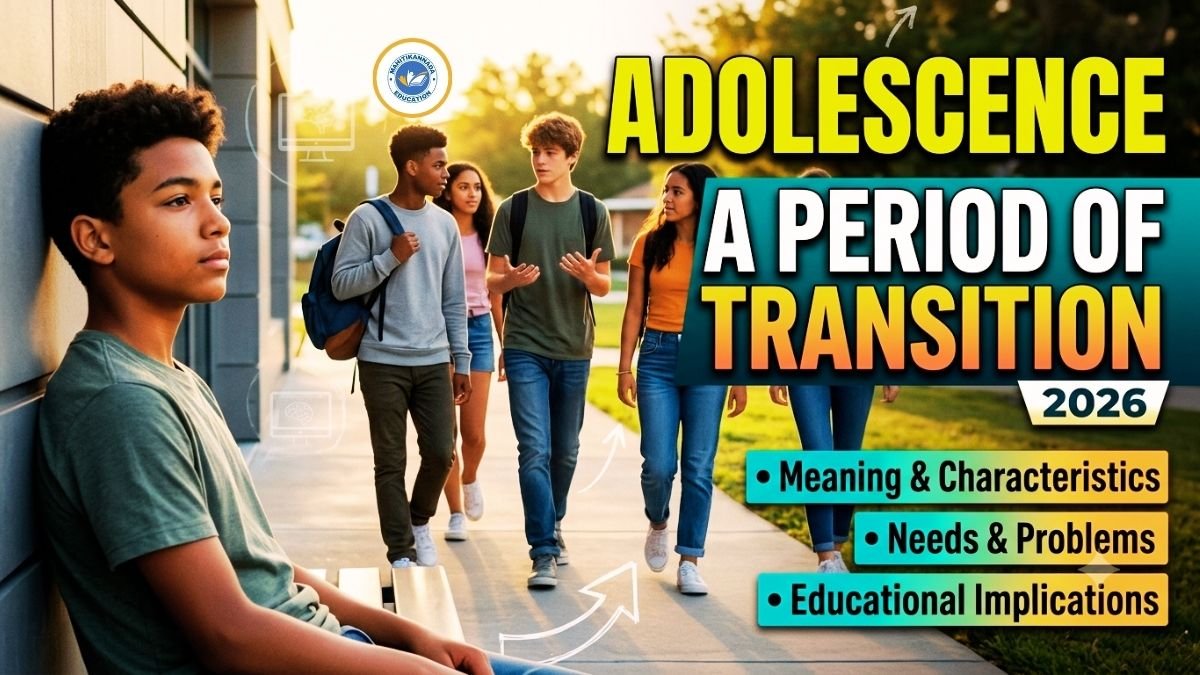
Adolescence as a Period of Transition: Meaning, Characteristics, Needs, Problems and Educational Implications
Adolescence as a Period of Transition: Learn about adolescence as a period of transition, its meaning, definitions, needs, physical, cognitive, emotional, social, moral and language problems, and educational implications for TET and CTET exams.
Adolescence is one of the most important stages of human development. It is a transitional period between childhood and adulthood, characterized by rapid physical, cognitive, emotional, social, and moral changes. Understanding adolescence is essential for teachers, parents, educational psychologists, and students preparing for competitive examinations such as the Karnataka TET, CTET, and other teacher recruitment examinations.
In this article, we will discuss the meaning and definitions of adolescence, the major needs of adolescents, the physical, cognitive, emotional, social, moral, and language-related problems they may experience, and the role of education in addressing these challenges.
1. What Is Adolescence?
Adolescence is the developmental period between childhood and adulthood. It is a stage during which individuals experience significant physical, psychological, emotional, and social changes as they move towards maturity.
Generally, adolescence is associated with the ages of 12 to 18 years in school-level educational psychology. However, the exact age range varies among individuals and developmental frameworks.
Adolescence is often described as a period of transition because individuals gradually move from childhood dependence towards adult independence and responsibility.
During this stage, adolescents develop their own opinions, explore their identities, establish relationships, and begin making decisions about their education, careers, and future lives.
Meaning of the Term Adolescence
The English word Adolescence is derived from the Latin word Adolescere, which means “to grow to maturity.”
This meaning reflects the fundamental nature of adolescence: the gradual process of developing physical maturity, intellectual abilities, emotional regulation, and social responsibility.
Why Is Adolescence Called a Period of Transition?
Adolescence is called a period of transition for the following reasons:
- It marks the transition from childhood to adulthood.
- Rapid physical growth takes place.
- Sexual maturation and hormonal changes occur.
- Thinking and reasoning abilities develop.
- Emotional experiences may become more intense.
- Relationships with parents, teachers, and peers change.
- Adolescents begin developing their personal identities.
- They seek greater independence and responsibility.
- Their moral values and beliefs develop further.
- They begin exploring future educational and career opportunities.
Therefore, adolescence is a crucial period that influences an individual’s personality, behaviour, relationships, and future development.
2. Definitions of Adolescence
Several psychologists and developmental theorists have explained adolescence from different perspectives.
1. A. T. Jersild
A. T. Jersild described adolescence as a period during which boys and girls move from childhood towards adulthood through physical, mental, emotional, social, sexual, and intellectual development.
Explanation: This definition emphasizes that adolescence involves several dimensions of development rather than physical growth alone.
2. G. Stanley Hall
G. Stanley Hall famously described adolescence as a period of “storm and stress.”
Explanation: According to Hall’s perspective, adolescence may involve emotional conflict, tension, uncertainty, and struggles for independence.
However, not every adolescent experiences severe emotional difficulties. The nature and intensity of these experiences vary according to individual characteristics, family relationships, culture, and social circumstances.
3. Madison and Johnson
In the supplied educational material, adolescence is described as a period beginning with the signs of sexual maturity and ending when an individual assumes adult roles and gains acceptance within the social group.
Explanation: This view emphasizes the relationship between physical maturation and social adjustment.
4. Definition Emphasizing the Transition to Adulthood
Adolescence may also be understood as the final stage of childhood and the beginning of adult life.
Explanation: During this period, individuals gradually acquire the abilities, responsibilities, and social experiences necessary for adult life.
3. Characteristics of Adolescence
Adolescence has several distinctive characteristics.
1. Rapid Physical Growth
Adolescents experience rapid changes in height, weight, body proportions, and physical strength. These changes are associated with puberty and hormonal activity.
2. Sexual Maturation
The reproductive system develops, and secondary sexual characteristics appear. Adolescents may become more curious about sexuality, relationships, and bodily changes.
3. Cognitive Development
Thinking abilities become increasingly sophisticated. Adolescents develop stronger capacities for abstract reasoning, problem-solving, planning, and considering different possibilities.
4. Emotional Development
Adolescents may experience intense emotions, including happiness, sadness, anger, fear, excitement, and anxiety.
Their ability to regulate these emotions continues to develop.
5. Development of Identity
Adolescents begin exploring questions such as:
- Who am I?
- What are my interests and abilities?
- What values are important to me?
- What kind of person do I want to become?
- What career should I choose?
6. Desire for Independence
Adolescents increasingly want to make decisions independently. They may question parental rules and seek greater participation in decisions affecting their lives.
7. Influence of Peer Groups
Friendships and peer relationships become increasingly important. Adolescents may seek acceptance, appreciation, and recognition from people of their own age.
8. Development of Moral Values
Adolescents increasingly examine social rules, fairness, justice, responsibility, and personal beliefs.
9. Career Awareness
They begin considering future occupations, educational pathways, and the skills required for employment.
10. Individual Differences
Adolescents do not all develop at the same rate. Physical maturity, emotional development, interests, abilities, and social adjustment vary considerably among individuals.
4. Needs of Adolescents
Adolescence is a period of considerable change. Adolescents have several developmental needs that should be understood and addressed by parents, teachers, and society.
When these needs are neglected, some adolescents may experience frustration, conflict, anxiety, or difficulties in adjustment.
The major needs of adolescence are explained below.
1. Need for Independence
Adolescents increasingly desire independence in their thoughts, decisions, activities, and relationships.
They want to express their opinions, make choices, and take responsibility for their actions.
Role of parents and teachers:
- Encourage independent thinking.
- Provide age-appropriate responsibilities.
- Allow adolescents to participate in decision-making.
- Explain rules and expectations clearly.
- Provide guidance without unnecessary control.
Independence should be encouraged alongside responsibility and safety.
2. Need for Achievement
Adolescents want to demonstrate their abilities and achieve recognition in different areas of life.
They may seek success in academics, sports, music, art, leadership, or other activities.
Achievement helps develop confidence, competence, and a sense of personal worth.
Role of teachers:
- Set realistic and achievable goals.
- Recognize effort and improvement.
- Provide opportunities to demonstrate different abilities.
- Encourage participation in competitions and extracurricular activities.
- Avoid comparing students unfairly.
3. Need for Identity
Identity development is one of the central tasks of adolescence.
Adolescents want to understand their interests, abilities, values, preferences, and place in society.
They may experiment with different activities, styles, opinions, and future goals while developing a clearer sense of self.
Role of parents and teachers:
- Respect individual differences.
- Encourage self-expression.
- Provide constructive feedback.
- Avoid humiliating or labelling adolescents.
- Support the development of a positive self-image.
4. Need for Accurate Sexual Education
Puberty brings physical changes, sexual maturation, and increased curiosity about relationships and sexuality.
Without accurate information, adolescents may experience unnecessary fear, confusion, embarrassment, or vulnerability to misinformation.
Age-appropriate, scientifically accurate, and respectful sexual education should include:
- Puberty and bodily changes.
- Reproductive health.
- Personal hygiene.
- Consent and personal boundaries.
- Healthy relationships.
- Prevention of sexual harassment and abuse.
- Online safety and responsible behaviour.
- Access to reliable health information.
Sexual education should be provided without shame, discrimination, or misinformation.
5. Need for Financial Independence
Many adolescents begin thinking about earning money and becoming financially independent.
Although most school-age adolescents continue to depend on their families, they can gradually develop financial awareness and practical skills.
Role of education:
- Teach budgeting and saving.
- Introduce responsible spending.
- Provide career guidance.
- Develop practical and vocational skills.
- Explain the importance of education and employability.
Financial independence should be developed gradually, according to age, education, and individual circumstances.
6. Need for Ideals and Values
Adolescents begin examining the values and beliefs they have learned from their families and communities.
They may seek role models who represent honesty, courage, fairness, responsibility, achievement, and social service.
Role of teachers:
- Demonstrate ethical behaviour.
- Encourage critical thinking.
- Discuss real-life moral situations.
- Promote honesty, empathy, and respect.
- Introduce positive role models.
7. Need for Self-Reliance
Adolescents want to become capable of managing their activities and solving their own problems.
Self-reliance includes responsibility, decision-making, problem-solving, and confidence in one’s abilities.
Teachers can encourage self-reliance by assigning meaningful responsibilities, promoting independent learning, and allowing students to learn from reasonable mistakes.
8. Need for Social Recognition
Adolescents want to feel accepted, respected, and valued by their parents, teachers, friends, and communities.
They often appreciate opportunities to demonstrate their talents and contribute to group activities.
Role of schools:
- Encourage participation in school programmes.
- Provide leadership opportunities.
- Recognize different forms of achievement.
- Prevent bullying and discrimination.
- Create an inclusive school environment.
Summary of the Needs of Adolescents
The eight major needs discussed above are:
- Independence.
- Achievement.
- Identity.
- Accurate sexual education.
- Financial independence.
- Ideals and values.
- Self-reliance.
- Social recognition.
Meeting these needs appropriately supports healthy development and adjustment during adolescence.
5. Genesis of Problems During Adolescence
The expression Genesis of Problems During Adolescence refers to the origin or causes of difficulties that adolescents may experience during this developmental stage.
Adolescence itself is not a problem. However, rapid developmental changes, unrealistic expectations, lack of support, family conflict, peer pressure, and inadequate guidance may contribute to difficulties.
The major categories of adolescent problems include:
- Physical problems.
- Cognitive problems.
- Emotional problems.
- Social problems.
- Moral problems.
- Language development problems.
These categories are useful for educational psychology and examination preparation. In real life, however, the categories overlap, and one difficulty may influence several areas of development.
6. Physical Problems During Adolescence
Physical problems refer to difficulties associated with bodily changes, puberty, appearance, health, and adjustment to physical maturation.
1. Adjustment to Physical Changes
Adolescents may experience rapid increases in height and weight, changes in body proportions, changes in voice, increased sweating, and changes in skin condition.
When they do not understand these changes, they may feel confused or worried.
For example, an adolescent may wonder why their body is developing earlier or later than that of their classmates.
Educational response:
Teachers and parents should explain that puberty is a natural process and that its timing differs from person to person.
2. Concerns About Physical Appearance
Adolescents often become more conscious of their appearance.
They may compare their height, weight, skin, facial features, or body shape with those of their peers and people portrayed in the media.
Unrealistic beauty standards can contribute to low self-esteem, dissatisfaction with appearance, or unhealthy attempts to change the body.
Educational response:
- Promote body positivity.
- Discourage teasing about appearance.
- Teach healthy personal hygiene.
- Explain the influence of unrealistic media images.
- Encourage confidence based on abilities, character, and personal qualities.
3. Puberty and Sexual Development
Sexual maturation may produce curiosity, uncertainty, embarrassment, and questions about relationships.
Adolescents need reliable information about reproductive health, personal boundaries, consent, and healthy relationships.
Educational response:
Schools and families should provide age-appropriate health education and create safe opportunities for adolescents to ask questions.
4. Changes in Physical Energy and Health
Adolescents may experience changes in sleeping patterns, appetite, energy levels, and daily routines.
Insufficient sleep, poor nutrition, inactivity, or excessive screen use may affect concentration and general well-being.
Educational response:
Encourage balanced nutrition, adequate sleep, physical activity, and healthy daily routines.
5. Anxiety About Development
Some adolescents become anxious when their bodies develop differently from those of their peers.
They may worry about whether their growth is normal.
Educational response:
Provide accurate information, reassure them about normal individual differences, and recommend consultation with a qualified healthcare professional when there are genuine health concerns.
7. Cognitive Problems During Adolescence
Cognitive development refers to changes in thinking, memory, reasoning, language, attention, planning, and problem-solving.
Although adolescents generally develop more advanced thinking abilities, they may still experience learning difficulties or challenges in applying those abilities consistently.
1. Language-Related Difficulties
Some adolescents may have difficulty expressing their thoughts clearly, participating in discussions, or understanding unfamiliar vocabulary.
These difficulties may arise from limited vocabulary, language-learning challenges, anxiety, or inadequate opportunities for communication.
Remedies:
- Encourage reading.
- Organize discussions and debates.
- Provide vocabulary-building activities.
- Encourage presentations and storytelling.
- Support students who are learning in a second language.
2. Abstract Thinking Difficulties
Adolescents increasingly develop the ability to think abstractly and consider hypothetical situations.
However, this ability develops gradually and varies among individuals.
Some students may struggle with abstract concepts in mathematics, science, philosophy, or other subjects.
Remedies:
Teachers should use concrete examples, demonstrations, diagrams, activities, and real-life situations before introducing difficult abstract concepts.
3. Behavioural Difficulties
Differences in cognitive development, emotional regulation, attention, and social understanding may influence behaviour.
Some adolescents may struggle to evaluate consequences, resolve disagreements, or respond appropriately to challenging situations.
Such difficulties should not automatically be interpreted as laziness or deliberate disobedience.
Remedies:
Teachers should identify the underlying causes, provide clear expectations, and teach decision-making and problem-solving skills.
4. Confusion About Goals
Adolescents may be uncertain about their educational goals, interests, or future careers.
They may find it difficult to choose between different opportunities.
Remedies:
- Provide career guidance.
- Help students identify their interests and strengths.
- Teach goal-setting.
- Encourage realistic planning.
- Discuss different educational and vocational pathways.
5. Identity-Related Difficulties
Adolescents may compare themselves with classmates, friends, or successful individuals.
Unfavourable comparisons can sometimes lead to feelings of inadequacy or confusion about personal abilities.
Remedies:
Teachers should recognize individual progress, encourage self-reflection, and help students develop realistic personal goals.
6. Difficulties Managing Distractions
Romantic interests, social relationships, digital media, and other activities may sometimes compete with academic responsibilities.
However, these interests do not automatically interfere with learning. Difficulties are more likely when students lack effective time-management and self-regulation skills.
Remedies:
- Encourage structured study schedules.
- Teach time-management skills.
- Promote healthy digital habits.
- Break large assignments into smaller tasks.
- Help students balance academics with recreation.
7. Negative Thinking
Some adolescents may develop negative beliefs about their abilities or future, particularly after repeated academic difficulties or social rejection.
Remedies:
Teachers should encourage realistic optimism, constructive self-talk, persistence, and learning from mistakes.
8. Lack of Guidance
Adolescents may struggle when they cannot access appropriate academic, emotional, or career guidance.
Remedies:
Schools should provide counselling, mentoring, academic support, and opportunities to discuss personal concerns confidentially.
9. Irregular Study Habits
Inconsistent routines, procrastination, poor sleep, and ineffective study techniques may affect learning.
Remedies:
Encourage regular revision, active recall, practice exercises, adequate sleep, and manageable study goals.
8. Emotional Problems During Adolescence
Emotional development is an important part of adolescence.
Adolescents may experience strong feelings as they respond to physical changes, changing relationships, academic expectations, and questions about identity.
Not all emotional changes indicate a problem. Difficulties become more concerning when they are persistent, intense, or interfere with everyday functioning.
1. Conflict Between Ideals and Reality
Adolescents may develop ambitious dreams and idealistic expectations.
When reality does not match these expectations, they may feel disappointed or uncertain.
For example, a student may want to achieve excellent examination results but struggle with particular subjects.
Remedy: Help adolescents establish realistic goals, recognize progress, and develop strategies for overcoming setbacks.
2. Resistance to Rules
Some adolescents question rules and resist what they perceive as unnecessary interference.
This behaviour may reflect a growing desire for independence, although other factors may also contribute.
Remedy: Adults should explain rules clearly, listen to adolescents’ perspectives, and provide appropriate opportunities for negotiation and responsibility.
3. Risk-Taking and Harmful Behaviour
Some adolescents may engage in risky behaviour because of peer pressure, impulsivity, emotional distress, limited supervision, or a desire for acceptance.
Examples can include substance use, dangerous activities, bullying, and other harmful behaviours.
However, these behaviours are not inevitable features of adolescence.
Remedy:
- Develop decision-making skills.
- Encourage supportive friendships.
- Provide accurate information about risks.
- Establish clear and fair boundaries.
- Offer timely counselling and support.
4. Development of Conscience
Adolescents increasingly reflect on right and wrong and become more aware of how their actions affect others.
They may experience guilt, shame, or uncertainty when their actions conflict with their values.
Remedy: Encourage ethical reflection, empathy, accountability, and constructive ways of correcting mistakes.
5. Fear and Anxiety
Adolescents may worry about examinations, physical appearance, relationships, peer acceptance, or future careers.
Remedies:
- Teach relaxation and coping skills.
- Encourage open communication.
- Provide academic support.
- Avoid unnecessary pressure.
- Refer persistent or severe anxiety to a qualified professional.
6. Anxiety About Appearance
Concerns about body image may make some adolescents reluctant to participate in social activities.
Remedy: Promote acceptance, discourage appearance-based criticism, and provide support when body-image concerns become distressing.
7. Struggles With Independence
Adolescents may want freedom while still depending on adults for emotional, practical, and financial support.
This can create tension between their desire for independence and their need for guidance.
Remedy: Gradually increase responsibilities while maintaining a supportive relationship.
8. Confusion About Social Status
Adolescents may be concerned about their popularity, social acceptance, academic performance, or position within a peer group.
Remedy: Emphasize cooperation, personal growth, and respect rather than popularity or constant comparison.
9. Difficulties in Romantic Relationships
Adolescents may experience attraction, affection, disappointment, jealousy, or uncertainty about relationships.
Remedy: Provide age-appropriate education about consent, boundaries, mutual respect, communication, and emotional well-being.
10. Anger, Jealousy, and Worry
Some adolescents find it difficult to regulate strong emotions.
Remedy: Teach emotional awareness, communication, conflict resolution, and healthy coping strategies.
Persistent sadness, severe anxiety, self-harm, or significant changes in behaviour should be taken seriously and addressed with appropriate professional support.
9. Social Problems During Adolescence
Social development involves learning how to interact with family members, friends, teachers, and the wider community.
Adolescents may experience social difficulties as their relationships and expectations change.
1. Lack of Happiness and Social Satisfaction
Adolescents who feel excluded, misunderstood, or unsupported may experience loneliness or dissatisfaction.
Some may withdraw from social activities.
Remedies:
- Create opportunities for friendship and cooperation.
- Encourage inclusive group activities.
- Prevent bullying.
- Provide emotional support.
- Help students develop healthy communication skills.
2. Adjustment Problems
Adolescents may struggle to adjust to changes in their bodies, family expectations, school environments, or peer relationships.
Differences in personality and communication styles may also lead to conflict.
Remedies:
Teachers should promote empathy, cooperation, conflict resolution, and respect for individual differences.
3. Family Relationship Problems
Adolescents may seek more freedom while parents continue to emphasize protection, discipline, and responsibility.
Misunderstandings can arise over friendships, clothing, academic performance, personal choices, and household responsibilities.
Remedies:
- Encourage respectful communication.
- Listen to adolescents without immediately judging them.
- Establish clear and reasonable boundaries.
- Involve adolescents in appropriate family decisions.
- Avoid humiliation, threats, and excessive punishment.
4. Career and Self-Reliance Problems
Adolescents may feel uncertain about their future occupations and the educational qualifications required for different careers.
Limited financial resources or a lack of career information may increase this uncertainty.
Remedies:
Schools should provide career counselling, information about educational pathways, vocational exposure, and opportunities to identify personal strengths.
5. Peer Pressure
Adolescents often value acceptance by their friends.
Some may feel pressured to adopt certain behaviours, styles, opinions, or habits to remain part of a group.
Remedies:
Teach assertiveness, independent decision-making, refusal skills, and the importance of choosing supportive friends.
6. Difficulty Adapting to Change
Physical, emotional, and social changes may make adolescents uncertain about how they should behave in different situations.
Remedy: Provide supportive guidance, predictable expectations, and opportunities to practise interpersonal skills.
7. Conflicts Between Personal Freedom and Responsibility
Adolescents may want to make their own choices but may not always fully consider the consequences.
Remedy: Give them appropriate responsibilities and help them understand how choices affect themselves and others.
8. Irritability and Social Conflict
Stress, lack of sleep, misunderstandings, and difficulty regulating emotions may contribute to arguments or disagreements.
Remedy: Teach communication, emotional regulation, and peaceful conflict resolution.
9. Conflict at Home and School
Misunderstandings between adolescents and adults may lead to repeated disagreements.
Remedy: Establish respectful communication between students, parents, teachers, and school counsellors.
10. Antisocial or Harmful Behaviour
In some circumstances, family difficulties, exposure to violence, social exclusion, peer pressure, or inadequate support may contribute to harmful behaviour.
Lying, theft, bullying, and repeated rule-breaking require careful attention to their underlying causes.
Remedy: Provide fair discipline, positive role models, counselling, family support, and opportunities for constructive participation.
11. Excessive Dependence on Peer Groups
Peer groups can provide friendship and support, but unhealthy group pressure may encourage harmful decisions.
Remedy: Encourage positive peer relationships, teamwork, independent judgement, and constructive extracurricular activities.
12. Low Self-Esteem
Repeated criticism, bullying, academic struggles, or negative comparisons may affect an adolescent’s confidence.
Remedy: Recognize strengths, encourage progress, and provide appropriate academic and emotional support.
13. Career Selection Difficulties
Choosing a future career can be stressful when adolescents lack information about their interests, abilities, and available opportunities.
Remedy: Offer career assessments, counselling, exposure to different occupations, and realistic educational planning.
10. Moral Problems During Adolescence
Moral development involves understanding values, ethical principles, responsibilities, and the consequences of one’s actions.
During adolescence, individuals may examine previously accepted rules and develop more independent moral reasoning.
Difficulties can arise when adolescents lack guidance, experience conflicting expectations, or struggle to apply their values in real-life situations.
1. Questioning Traditional Practices
Adolescents may question family customs, social traditions, and established beliefs.
Questioning traditions is not necessarily a moral problem. It can be part of developing independent judgement.
Educational response: Encourage respectful discussion, critical thinking, and an understanding of the reasons behind social rules.
2. Disregard for Social Responsibilities
Some adolescents may disregard responsibilities or engage in behaviour that harms others.
Educational response: Teach empathy, accountability, cooperation, and respect for others’ rights.
3. Lack of Ethical Guidance
When adolescents receive inconsistent guidance or lack positive role models, they may find it difficult to evaluate complicated moral situations.
Educational response: Discuss real-life examples involving honesty, fairness, responsibility, respect, and compassion.
4. Excessive Time With Peer Groups
Spending time with friends is a normal part of development.
However, group pressure may sometimes encourage rule-breaking or harmful behaviour.
Educational response: Encourage positive friendships and teach adolescents to make independent decisions.
5. Difficulty Developing Personal Values
Adolescents may experience conflicts between personal beliefs, family expectations, peer opinions, and social norms.
Educational response: Help students examine values thoughtfully and understand the consequences of their decisions.
How Can Moral Development Be Encouraged?
Schools and families can support moral development through:
- Value education.
- Cooperative learning.
- Community service.
- Positive role modelling.
- Classroom discussions.
- Fair and consistent rules.
- Respect for diversity.
- Encouragement of honesty and responsibility.
Moral education should develop understanding and responsible decision-making rather than relying solely on punishment or obedience.
11. Language Development Problems During Adolescence
Language development generally continues throughout adolescence.
Vocabulary, comprehension, communication skills, and the ability to discuss abstract ideas may improve significantly during this period.
Nevertheless, some adolescents experience language-related difficulties.
1. Limited Vocabulary
A limited vocabulary may make it difficult for students to express ideas or understand complex academic material.
Remedies:
- Encourage regular reading.
- Teach subject-specific vocabulary.
- Organize discussions.
- Use vocabulary journals.
- Encourage students to explain concepts in their own words.
2. Incorrect Grammatical Usage
Some adolescents may struggle with grammar, sentence construction, or the appropriate use of language in academic situations.
Remedies:
Teachers should provide explicit instruction, examples, writing practice, and constructive feedback.
3. Difficulty Remembering Words
Some students may struggle to recall appropriate words during conversations or written assignments.
Such difficulties can have several causes and should not automatically be attributed to poor memory.
Remedies: Encourage reading, regular practice, vocabulary revision, and supportive speaking activities.
4. Problems in Communication
Adolescents may find it difficult to communicate their thoughts clearly, particularly when discussing unfamiliar topics or speaking before a group.
Remedies:
- Conduct debates.
- Organize group discussions.
- Encourage public speaking.
- Use role-play activities.
- Provide a safe environment for making mistakes.
5. Influence of Other Languages
Students who use several languages may sometimes transfer vocabulary, pronunciation, or grammatical patterns from one language to another.
This is a normal aspect of multilingual language development and does not necessarily indicate a language disorder.
Remedies: Provide opportunities to practise each language in appropriate contexts and explain differences between language structures without discouraging multilingualism.
6. Limited Participation in Group Activities
Students who rarely participate in discussions may have fewer opportunities to practise speaking and listening skills.
However, limited participation may also reflect shyness, anxiety, language-learning needs, or personal preference.
Remedies: Use small-group activities, pair work, presentations, and supportive classroom discussions.
12. Challenges of Adolescence to Education
Adolescence presents important challenges for the education system.
Schools must respond to the developmental needs of adolescents while helping them acquire knowledge, skills, values, and the ability to make responsible decisions.
The role of education is not merely to control adolescent behaviour. It is to understand adolescents and provide conditions that support their overall development.
1. Understanding Adolescent Psychology
Teachers should understand the physical, cognitive, emotional, and social characteristics of adolescence.
This knowledge helps them recognize developmental differences and respond appropriately to students’ needs.
Educational implication: Teachers should avoid interpreting every disagreement, emotional reaction, or mistake as deliberate misconduct.
2. Providing a Suitable School Environment
Schools should provide a safe, supportive, inclusive, and stimulating learning environment.
Students should feel respected and confident enough to participate in classroom activities.
Educational implication: Establish clear rules, prevent bullying, encourage cooperation, and treat students fairly.
3. Providing Appropriate Sexual Education
Adolescents need accurate information about puberty, reproductive health, consent, personal safety, and healthy relationships.
Educational implication: Schools should provide age-appropriate, scientifically accurate education and answer questions respectfully.
4. Developing Emotional Intelligence
Students should learn to identify, understand, express, and regulate their emotions.
Educational implication: Activities involving reflection, communication, empathy, and conflict resolution can strengthen emotional skills.
5. Maintaining Healthy Teacher-Student Relationships
Adolescents need respectful relationships with teachers.
Discrimination based on gender, caste, economic background, language, disability, or academic performance can harm students’ sense of belonging.
Educational implication: Teachers should maintain fairness, confidentiality where appropriate, and respectful communication.
6. Encouraging Identity and Self-Expression
Adolescents need opportunities to explore interests, demonstrate abilities, and express ideas.
Educational implication: Schools should provide opportunities for leadership, creative activities, student participation, and responsible decision-making.
7. Recognizing Individual Interests
Adolescents may have different interests in science, sports, arts, literature, technology, leadership, or vocational activities.
Educational implication: Teachers should recognize different talents rather than evaluating every student solely through examination marks.
8. Organizing Extracurricular Activities
Extracurricular activities support social development, cooperation, leadership, creativity, and physical well-being.
Examples include:
- Sports and games.
- Music and dance.
- Debates and quizzes.
- Art and craft.
- Drama and cultural programmes.
- Science exhibitions.
- Community service.
- Environmental activities.
9. Considering Individual Differences
Students differ in learning pace, interests, language abilities, physical development, and emotional needs.
Educational implication: Teachers should use varied teaching methods, differentiated instruction, and appropriate learning support.
10. Providing Educational and Personal Guidance
Adolescents may need assistance with academic planning, friendships, family concerns, emotional difficulties, and career decisions.
Educational implication: Schools should provide guidance services and refer students to qualified professionals when necessary.
11. Setting Realistic Expectations
Teachers should avoid expecting every student to perform beyond their developmental level or current abilities.
Educational implication: Set challenging but achievable goals, provide additional support, and recognize improvement.
12. Providing Health and Mental Health Education
Adolescents should learn about physical health, hygiene, sleep, nutrition, emotional well-being, and the importance of seeking help.
Educational implication: Schools should promote healthy routines and make appropriate health and counselling resources accessible.
13. Promoting Moral and Value Education
Education should help adolescents develop honesty, empathy, responsibility, respect, fairness, and concern for society.
Educational implication: Values should be reinforced through everyday classroom practices, not just theoretical lessons.
14. Strengthening Cooperation Between School and Family
Adolescent development is influenced by both home and school environments.
Educational implication: Teachers and parents should communicate constructively and work together to support students’ learning and well-being.
15. Encouraging Critical Thinking and Decision-Making
Adolescents benefit from opportunities to examine evidence, compare alternatives, solve problems, and consider consequences.
Educational implication: Use projects, discussions, case studies, inquiry-based learning, and problem-solving activities.
13. Role of Teachers in Adolescent Development
Teachers play a significant role in helping adolescents adjust to developmental changes.
Their responsibilities include the following:
- Understanding adolescent psychology.
- Respecting individual differences.
- Creating a supportive classroom.
- Encouraging independent thinking.
- Providing constructive feedback.
- Recognizing students’ achievements.
- Preventing bullying and discrimination.
- Promoting healthy peer relationships.
- Supporting emotional regulation.
- Providing academic and career guidance.
- Encouraging sports and extracurricular activities.
- Teaching ethical decision-making.
- Communicating respectfully with parents.
- Recognizing signs of serious distress.
- Referring students to qualified professionals when needed.
Teachers should act as facilitators, mentors, and supportive adults rather than relying exclusively on authority and punishment.
14. Role of Parents in Solving Adolescent Problems
Parents provide an important foundation for adolescents’ emotional security and social development.
They can support adolescents through the following practices:
1. Maintain Open Communication
Parents should listen carefully and allow adolescents to discuss their concerns without fear of immediate criticism.
2. Respect Growing Independence
Provide opportunities for age-appropriate decision-making while maintaining reasonable safety boundaries.
3. Avoid Excessive Comparison
Comparing adolescents with siblings, relatives, or classmates can damage confidence and increase stress.
4. Encourage Positive Habits
Promote adequate sleep, healthy nutrition, physical activity, regular study, and balanced technology use.
5. Provide Emotional Support
Adolescents should know that they can approach their parents when they experience difficulties.
6. Discuss Peer Pressure
Help adolescents recognize unhealthy pressure and practise ways to refuse unsafe or inappropriate activities.
7. Support Career Planning
Encourage adolescents to explore their interests and abilities rather than forcing them into a particular career.
8. Seek Professional Help When Necessary
Persistent emotional distress, severe behavioural changes, or difficulties that interfere with daily functioning may require support from a qualified healthcare or mental health professional.
15. Important Educational Implications of Adolescence
The following principles are especially important for teachers and educational psychology students.
Principle 1: Adolescence Is a Period of Transition
Teaching should recognize the transition from childhood towards adult independence and responsibility.
Principle 2: Individual Differences Must Be Respected
Physical, cognitive, and emotional development does not occur at exactly the same rate in every individual.
Principle 3: Adolescents Need Recognition
Opportunities for achievement, leadership, and creative expression can support confidence and motivation.
Principle 4: Independence Should Be Encouraged
Students should be given appropriate opportunities to make decisions and accept responsibility.
Principle 5: Emotional Support Is Essential
A supportive environment helps adolescents manage stress and participate more confidently in learning.
Principle 6: Guidance Is More Effective Than Humiliation
Constructive guidance, clear expectations, and fair consequences are generally more helpful than ridicule or harsh punishment.
Principle 7: Peer Relationships Influence Development
Schools should encourage positive friendships, cooperation, teamwork, and resistance to harmful peer pressure.
Principle 8: Education Should Be Holistic
Education should support physical, cognitive, emotional, social, moral, and language development.
Principle 9: Career Guidance Is Important
Adolescents need opportunities to understand their strengths, interests, educational options, and future career possibilities.
Principle 10: Family and School Cooperation Is Necessary
Parents, teachers, counsellors, and communities should work together to support adolescents’ well-being.
16. Difference Between Childhood and Adolescence
| Basis | Childhood | Adolescence |
|---|---|---|
| Developmental stage | Early period of human development | Transition from childhood to adulthood |
| Physical growth | Growth occurs throughout childhood | Puberty and rapid physical changes commonly occur |
| Thinking | Thinking develops from concrete experiences towards more complex reasoning | Abstract and hypothetical reasoning generally become more advanced |
| Emotional development | Emotional regulation develops gradually | Emotional experiences may become more complex |
| Independence | Greater dependence on adults is common | Desire for independence generally increases |
| Identity | Self-understanding develops | Identity exploration becomes especially important |
| Peer relationships | Friendships develop and become increasingly meaningful | Peer acceptance and group relationships may become particularly influential |
| Moral reasoning | Understanding of rules and fairness develops | Moral reflection and independent judgement may become more advanced |
| Career awareness | Interests begin to emerge | Educational and career planning often becomes more prominent |
| Responsibility | Responsibilities are generally more limited | Opportunities for greater responsibility increase |
Note: These are general developmental patterns. Individual differences mean that not every child or adolescent will show the same characteristics at the same age.
17. Quick Revision Notes for TET and CTET Exams
The following points are useful for quick revision before competitive examinations.
- Adolescence: A developmental period between childhood and adulthood.
- Latin origin: Adolescere.
- Meaning of Adolescere: To grow to maturity.
- Common school-level age range: Approximately 12–18 years, although age boundaries vary.
- G. Stanley Hall: Associated with the phrase “storm and stress.”
- Major developmental changes: Physical, cognitive, emotional, social, and moral.
- Need for independence: Desire to make decisions and accept responsibility.
- Need for achievement: Desire to demonstrate competence and attain goals.
- Need for identity: Desire to understand oneself and establish a personal identity.
- Need for social recognition: Desire to feel accepted and valued.
- Physical problems: Difficulties related to bodily changes and appearance.
- Cognitive problems: Possible difficulties with reasoning, attention, planning, or learning.
- Emotional problems: Anxiety, frustration, emotional conflict, or difficulty regulating feelings.
- Social problems: Difficulties involving peer relationships, family interactions, and adjustment.
- Moral development: Growth in ethical understanding and responsible decision-making.
- Language development: Continued development of vocabulary, comprehension, and communication.
- Role of teachers: Guidance, encouragement, individual support, and a positive learning environment.
- Role of parents: Communication, emotional security, appropriate boundaries, and support.
- Educational implication: Adolescents need understanding, guidance, independence, recognition, and opportunities for holistic development.
18. Frequently Asked Questions (FAQs)
Q1. What is adolescence?
Adolescence is the developmental period between childhood and adulthood, during which individuals experience important physical, cognitive, emotional, and social changes.
Q2. Why is adolescence called a period of transition?
It is called a period of transition because individuals move gradually from childhood towards physical maturity, greater independence, adult responsibilities, and more complex social relationships.
Q3. What is the meaning of the word Adolescence?
The word Adolescence is derived from the Latin word Adolescere, meaning “to grow to maturity.”
Q4. Who described adolescence as a period of storm and stress?
G. Stanley Hall is associated with the description of adolescence as a period of “storm and stress.”
Q5. What is the commonly accepted age range of adolescence in school-level educational psychology?
A common school-level range is approximately 12 to 18 years. However, adolescence does not begin or end at exactly the same age for everyone.
Q6. What are the major needs of adolescents?
The major needs include independence, achievement, identity, accurate sexual education, financial awareness, ideals and values, self-reliance, and social recognition.
Q7. What are the major problems experienced during adolescence?
The common educational psychology categories are physical, cognitive, emotional, social, moral, and language development problems.
Q8. What is identity development during adolescence?
Identity development is the process through which adolescents explore and develop an understanding of their interests, abilities, values, beliefs, and personal goals.
Q9. What is the role of teachers in adolescent development?
Teachers should understand adolescent psychology, provide a safe learning environment, respect individual differences, encourage independence, offer guidance, and support students’ overall development.
Q10. Why is sexual education important during adolescence?
Age-appropriate sexual education helps adolescents understand puberty, reproductive health, consent, personal boundaries, healthy relationships, and personal safety.
Q11. How can parents help adolescents manage emotional problems?
Parents can listen without judgement, maintain open communication, encourage healthy habits, establish reasonable boundaries, and seek professional help when necessary.
Q12. What are the educational implications of adolescence?
Education should provide supportive learning environments, individual guidance, emotional support, opportunities for independent thinking, extracurricular activities, career counselling, and moral education.
Q13. Is every adolescent affected by storm and stress?
No. Adolescents differ considerably in their experiences. Some experience significant conflict or emotional distress, while others navigate adolescence with relatively little difficulty.
Q14. How can schools reduce adolescent adjustment problems?
Schools can reduce difficulties by preventing bullying, promoting positive relationships, providing counselling, teaching life skills, encouraging participation, and cooperating with families.
Q15. Why is adolescence important in educational psychology?
Adolescence is important because developmental changes during this period influence learning, motivation, identity, relationships, behaviour, and preparation for adult responsibilities.
Conclusion
Adolescence is a significant period of transition between childhood and adulthood. It involves important changes in physical growth, cognitive abilities, emotions, social relationships, moral reasoning, and personal identity.
During this period, adolescents may seek independence, achievement, recognition, self-reliance, and a clearer understanding of their future. When their developmental needs are not adequately supported, they may experience difficulties related to learning, emotions, relationships, behaviour, or adjustment.
The role of education is to understand adolescents, guide them constructively, and create opportunities for their all-round development.
Teachers, parents, counsellors, and society should work together to provide adolescents with accurate information, emotional security, positive role models, appropriate independence, and a supportive environment.
Understanding adolescence as a period of transition is therefore essential for teachers preparing for TET, CTET, and other competitive examinations, as well as for anyone involved in the education and development of young people.

