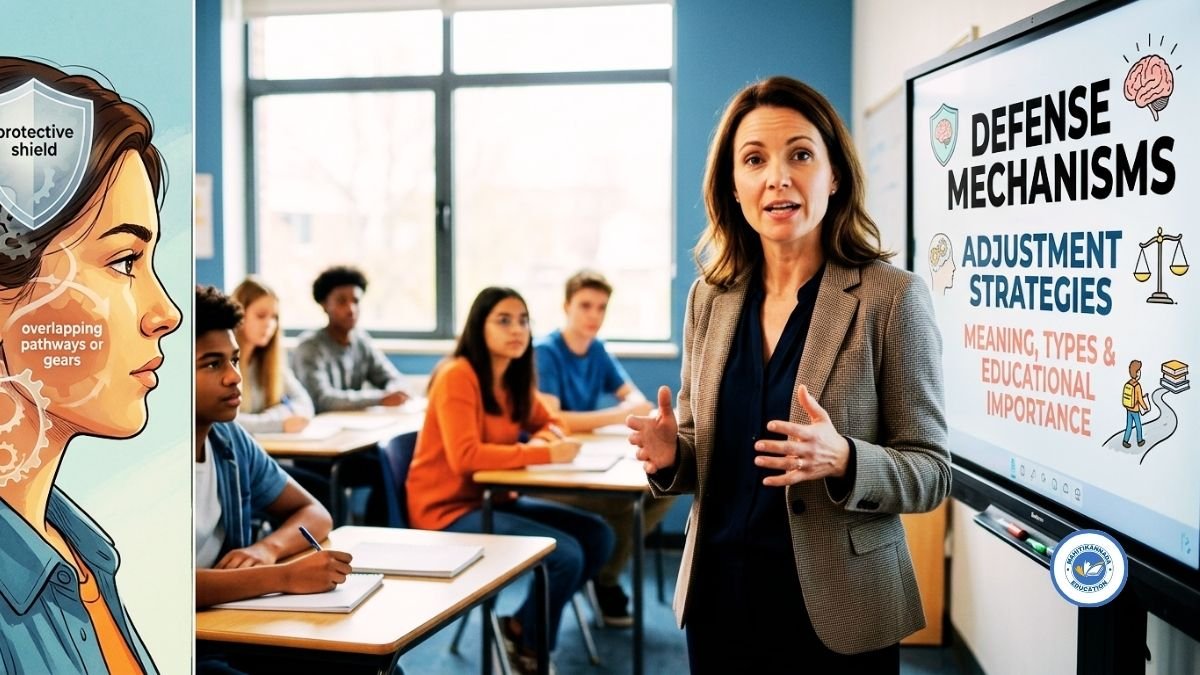
Defense Mechanisms and Adjustment Strategies: Meaning, Types, Examples and Educational Importance
Defense Mechanisms and Adjustment Strategies: Learn defense mechanisms and adjustment strategies, including repression, suppression, regression, rationalization, projection, sublimation and compensation, with examples for TET CTET and CET exams.
Human beings are intelligent, capable of thought, and inherently aspirational. Every individual possesses their own unique desires and aspirations, and they pursue various paths to fulfill them. Often, however, individuals fail to achieve these aspirations or goals. Regardless of the specific reason, the failure to realize one’s desires leads to disappointment. This can create a sense that one’s ego or prestige has been damaged, potentially giving rise to feelings of inferiority. Unable to reveal this disappointment or failure to others—and unwilling to acknowledge their own limitations—individuals may attempt to conceal the truth. In other words, they employ various strategies to cover up their own shortcomings. These are known as “defense mechanisms.” In one way or another, everyone utilizes such defense mechanisms to escape from emotional tension and disappointment. Defense mechanisms are acquired habits that offer temporary relief from stress and disappointment, helping to restore balance to one’s personality. Essentially, any method that helps an individual overcome obstacles, reach their goals, or move past disappointment—thereby maintaining a state of psychological balance—can be termed a “defense mechanism.” Definitions
• According to Carroll: Defense mechanisms are strategies employed to derive indirect satisfaction for a need, thereby reducing tension and preserving self-esteem.
• According to James Drever: Defense mechanisms refer to involuntary or unconscious patterns of behavior—whether physical or mental—that individuals frequently exhibit.
Thus, defense mechanisms are strategies that assist an individual in preserving their self-esteem. These strategies serve as temporary solutions; they are psychological in nature and largely operate at an unconscious level.
Types of Defense Mechanisms
Defense mechanisms can be broadly categorized into three main types. They are:
1. Aggressive Mechanisms
• Displacement
• Self-reproach (Self-blame)
2. Escape Mechanisms
• Repression
• Suppression
• Regression
• Rationalization
• Projection
• Daydreaming
3. Adjustment Mechanisms
• Identification
• Sublimation
• Compensation
Their descriptions are as follows:
1. Aggressive Mechanisms
In these types of defense mechanisms, an individual protects themselves by acting aggressively—either directly toward the source of an obstacle or, alternatively, toward another object or person. Key mechanisms in this category include:
• Displacement
• Self-reproach (Self-blame)
• Displacement: This mechanism occurs when an individual, instead of expressing their anger toward the specific person or object that caused it, directs that anger toward a less threatening person or object. By venting their anger on a weaker individual, the person finds relief from their frustration or anxiety. In this scenario, the weaker individual becomes a scapegoat (or victim).
Examples:
• A subordinate, having been scolded by a superior at the office, takes out their frustration on an office peon.
• A teacher, having been humiliated by the headmaster at school, vents their anger on the students in the classroom. • A younger brother, having been scolded or beaten by his elder brother at home, vents his anger by hitting his own younger sibling.
• Self-Blame Mechanism: In this type of mechanism, an individual begins to blame themselves. Unable to direct their anger toward the person or object that triggered it, they turn that anger inward by blaming themselves—a process known as self-reproach. By holding themselves responsible for their own disappointment, they create a form of psychological defense. This approach avoids causing harm to others while providing the individual with a temporary sense of relief from their anger.
Example:
• A parent, upon discovering a mistake made by their children, might choose to keep the matter to themselves—believing the children will not repeat the error—and instead direct the blame toward themselves.
2. Escape Mechanisms
In these types of strategies, an individual avoids using any form of aggressive tactics; instead, they employ an “escape mechanism” to withdraw from a given situation. Such mechanisms provide temporary protection to the individual without causing harm to others. The primary examples are as follows:
• Repression: This is a mechanism wherein thoughts associated with tension or distress are pushed from the conscious mind into the unconscious, or are buried deep within. It serves as a strategy for an individual to forget painful experiences, feelings of inferiority, or thoughts that lead to disappointment. Repression is a very common and functional mechanism; by burying distressing thoughts within themselves, an individual manages to find a sense of relief. Sigmund Freud described repression as a psychological process. According to him, an individual—wishing to avoid the pain associated with humiliation, disappointment, or guilt—relegates these distressing matters to the unconscious mind. This process occurs at an unconscious level.
• Suppression: Like repression, this is also a form of escape mechanism. However, in this case, the individual consciously chooses not to express painful experiences and instead pushes them into the subconscious (or unconscious) mind. While repression occurs at an unconscious level, suppression is an act carried out consciously. • **Regression:** This is a mechanism where an individual reverts to an earlier stage of development—specifically, childhood. It occurs when a person is unable to cope with or overcome certain challenges, leading them to exhibit behaviors typical of a younger age, which are inappropriate for their actual chronological age. It serves as an easy escape from stressful situations. Signs of regression include crying like a child, using baby talk, or sucking one’s thumb. Under the intense pressure of work responsibilities, individuals might cry like children or bite their nails. In some instances, women may bang their heads against a wall. Conversely, one might also dance around like a child when feeling joyful.
• **Rationalization:** This is a common mechanism used by individuals to protect their self-esteem. It involves justifying one’s failures or shortcomings by offering alternative explanations, rather than acknowledging the true reasons for one’s inability. The individual presents false reasons for their failure, using persuasive rhetoric to make others—and themselves—believe these explanations are the truth. When experiencing anxiety, a person may provide a seemingly logical or justifiable reason for their behavior to conceal the actual, underlying cause.
Examples:
• A person who scores low marks on an exam might argue that examinations are not the sole measure of intelligence.
• The classic fable of the fox who, unable to reach the grapes, claims they are sour, serves as an excellent example of this mechanism. • This is a defense mechanism commonly used by many people.
• However, it is a strategy through which an individual deceives themselves.
• Projection: ‘Projection’ is the act of attributing one’s own failures, shortcomings, or unacceptable emotions to another person. It is a mechanism where an individual perceives their own unacceptable traits or thoughts in someone else. Instead of acknowledging their own failures, the person employs a strategy to point out similar failures in others.
Examples:
• A person who has committed a wrongdoing might ask, “Doesn’t everyone make mistakes?”
• A corrupt official, rather than admitting their own misconduct, might argue, “Who isn’t corrupt? Everyone is corrupt!” By doing this, they attempt to shield themselves from accountability for their own actions.
• A person who is consistently late for work might claim, “Who actually manages their time properly? Everyone is like that!”
• A dishonest person might try to protect themselves by pointing out dishonest traits in others.
• Daydreaming: Daydreaming involves withdrawing from reality into a world of fantasy to fulfill one’s desires. When an individual’s wishes and aspirations remain unfulfilled in real life, they escape into a dream world to find solace. Examples:
• A young person with an interest in music—who is not a musician in real life—might slip into a world of dreams, imagining themselves as an accomplished musician and finding satisfaction therein.
• Individuals who have experienced failure in fields like sports, dance, or acting may derive psychological satisfaction by engaging in daydreams.
3. Adjustment Mechanisms
Adjustment mechanisms are strategies that facilitate an individual’s adaptation to their environment. Key examples include the following:
• Identification
• Sublimation
• Compensatory Mechanism
• Identification: This is a strategy where an individual associates themselves with another person to preserve or enhance their own self-esteem. This mechanism is frequently observed among young people, who often adopt figures such as teachers, artists, or social workers as role models and identify themselves with them.
Examples:
• A student adopting a teacher as an ideal and identifying with them.
• Female students adopting exemplary social workers or female leaders as ideals and identifying with them.
While this can encourage individuals to develop in the image of these role models, it may also compromise their own sense of individuality.
• Sublimation: This is a form of compensatory adjustment mechanism. Individuals who are unable to fulfill certain desires or aspirations may channel their energy into activities such as literary pursuits or social service to find satisfaction.
Example:
• A young housewife who fails to find fulfillment within her family or through her children might channel her energy into working as a nurse, caring for patients in a hospital. • When young people suffer from sexual dissatisfaction, they may engage in behaviors such as writing love poetry, reading sexually explicit literature, or viewing obscene imagery. Many psychologists note that some individuals experiencing sexual dissatisfaction channel their energy into dance, art, or music—a process known as *sublimation*.
• Compensation: This involves an individual finding success in one activity to make up for failure in another. A person who lacks ability or fails to achieve in one area may utilize their strengths in a different field to find a sense of fulfillment. This process helps boost their self-esteem and self-respect.
Examples:
• A child or student who struggles academically or in classroom studies finds satisfaction by demonstrating their abilities in sports.
• An individual who aspired to a government job but failed to secure one achieves success by pursuing self-employment instead.
• A woman who considers herself unattractive cultivates an attitude of love and compassion toward others in order to gain their affection and trust.
All the defense mechanisms mentioned above are merely temporary strategies employed by an individual to protect their self-esteem or sense of dignity. Everyone, at some point in their life, resorts to these mechanisms. By using these methods judiciously and with restraint—depending on the context—an individual can enhance their self-esteem or sense of honor, preserve their personality, and protect themselves from disappointment. However, one must remember that these measures are only temporary. The ideal path to personality adjustment is to face problems directly—without seeking alternative detours—and to resolve them with courage and in a natural manner.

