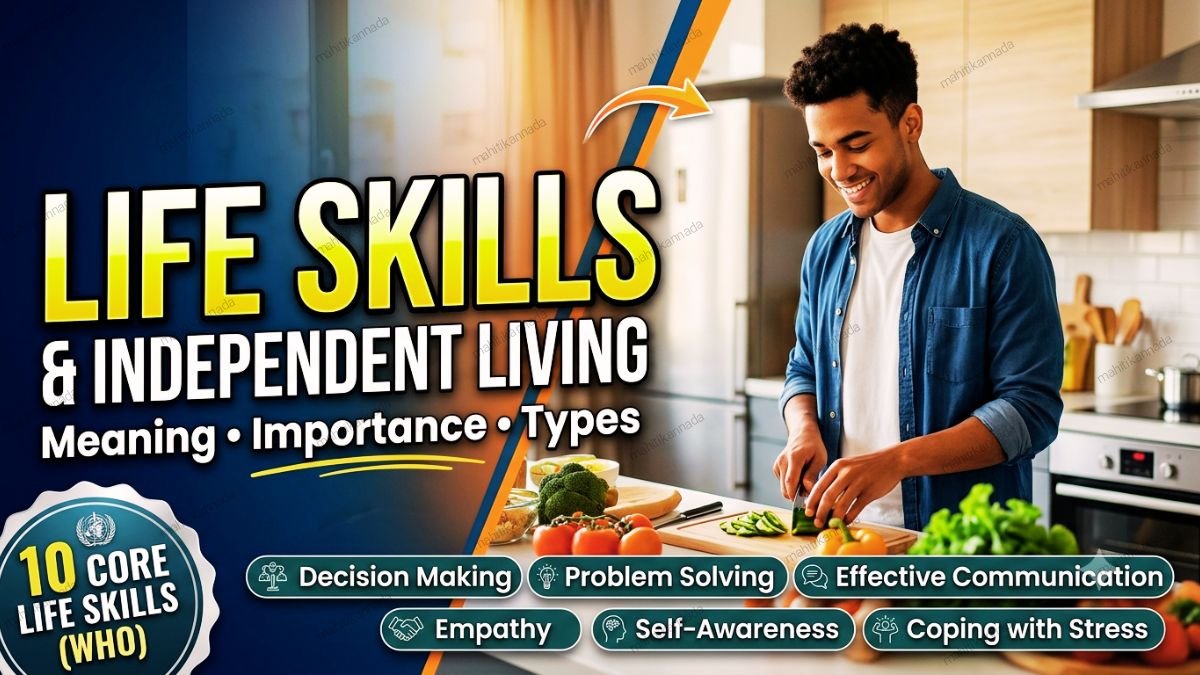
Life Skills and Independent Living: Meaning, Importance, Types and 10 Life Skills Identified by WHO
Life Skills and Independent Living: Learn the meaning, importance, and types of life skills, the 10 core life skills identified by WHO, independent living, and their importance for KTET,GPSTR, HSTR and CTET exams.
Nature has provided us with everything we need; intelligent humans have further reshaped and developed these natural resources. Even though everything we require exists around us, if we fail to adapt or organize these resources to suit our needs, we face failure—much like someone who dismantles a clock without knowing how to repair it. This raises the fundamental question: “How should one live?” Therefore, we need an education that empowers us to organize what is available and live effectively.
As modern life grows increasingly complex, students often find themselves entangled in multifaceted problems. Life skills prove invaluable here, equipping individuals with the capacity to overcome these diverse challenges and achieve success.
For every human being, success and happiness are the ultimate aspirations behind every effort. Education strives to ensure that this success becomes attainable for everyone. The very word “success” evokes immense joy. When the mind yearns for success, the windows of opportunity swing open; at such moments, one must possess the necessary wisdom and knowledge. Life skills are the competencies acquired to navigate life in alignment with the norms and expectations of society. They serve as our constant companions, guiding us as we journey toward the ultimate goal of a successful life. Life skills are essential for everyone to lead a prosperous life.
Concept of Life Skills
When life skills are effectively integrated, an individual can live a happy life while also safeguarding the well-being of their family, neighborhood, and society. Behaviors that are worthy of emulation—bringing joy to both the individual and society—can be termed “life skills.”
- World Health Organization (1993): Life skills are those abilities that help an individual personally cope with the demands and challenges of daily life and cultivate positive behavior.
- UNICEF (2004 Report): Healthy development in children should be fostered by integrating life skills into the teaching-learning process (Life Skills-Based Education – LSBE).
- National Curriculum Framework (NCF – 2005): The NCF emphasizes the inclusion of life skills, noting that they contribute significantly to enabling children to perceive and interpret the world independently, respond proactively and appropriately to various situations, participate actively in democratic processes, and drive social and economic change.
Importance of Life Skills
Life skills are essential for leading a prosperous life. Their significance is as follows:
- Life skills transform knowledge, attitudes, and values into practical, real-world capabilities.
- High-risk behaviors—such as alcohol consumption, drug use, and illicit relationships—often stem from boredom, aggression, confusion, peer pressure, or curiosity. These factors can lead to emotional distress, conflict, frustration, and tension, which in turn drive individuals toward risky conduct. In such situations, life skills training serves as a tool that empowers young people to act responsibly and exercise self-control.
- They enhance self-confidence and self-esteem.
- Life skills provide the capacity to face the realities of life and the competence necessary to ensure the overall well-being of young people.
- When young people become entangled in daily conflicts, problematic relationships, or peer pressure, they may end up engaging in anti-social activities. Through life skills training, they can learn to manage these challenges and instead participate in constructive societal activities.
- Life skills are instrumental in achieving success and leading a fulfilling life.
- They are helpful in fostering the development of a well-rounded personality.
- Life skills are helpful in becoming recognized as ideal individuals within society.
- Life skills are techniques designed to foster a balanced development across three domains—knowledge, attitude, and skills—thereby facilitating behavioral change.
Life Skills as Laid Down by the WHO
In today’s competitive world, life skills are essential—not only to achieve personal success but also to live effectively while allowing others to do the same. In 1997, the World Health Organization (WHO) identified ten life skills and advocated for their adoption. They are as follows:
- Critical Thinking
- Creative Thinking
- Decision Making
- Problem Solving
- Effective Communication
- Interpersonal Relationships
- Coping with Stress
- Coping with Emotions
- Self-Awareness
- Empathy
1. Critical Thinking
Critical thinking serves as the foundation for various other life skills, such as creative thinking, decision-making, and empathy.
It is an intellectual process that involves perceiving an object, subject, person, or situation from various dimensions to arrive at one’s own independent conclusion.
Critical thinking aids in maintaining good health by enabling individuals to identify and evaluate factors that influence their attitudes and behaviors—such as personal values, peer pressure, and the influence of media.
An inquisitive mindset is the lifeblood of critical thinking. Therefore, we can cultivate this skill by engaging in self-reflection and discussing ideas with others.
The capacity for critical thinking is instrumental in enabling individuals to lead independent and fulfilling lives.
2. Creative Thinking
Creativity is the process of generating new ideas or creating new objects. It represents a fresh perspective or activity comprising four key components: fluency, flexibility, originality, and elaboration.
This skill can be cultivated through techniques such as brainstorming, gamification, ‘methetics’ (creative problem-solving/learning strategies), and elaboration.
Possessing creative thinking abilities helps individuals lead independent and enriched lives.
3. Decision Making
Decision-making involves examining a problem from various perspectives and selecting the most appropriate course of action. It is the process of choosing the right option—suited to the specific context—from among several available alternatives.
When making decisions in any situation, one must consider all available options and evaluate their potential consequences. While it may be helpful to seek the opinions of others, the final decision should be one’s own; this approach paves the way for success in all areas of life. Furthermore, it enables us to navigate our daily lives constructively and maintain our well-being.
4. Problem Solving
Problem solving plays a significant role in an individual’s daily activities. It is a cognitive process that drives one toward achieving a goal. The solution to every problem lies within our own minds; by understanding the gravity of a situation and engaging in thoughtful reflection, one can identify an appropriate solution. Approaches to finding solutions vary from person to person.
Problem solving refers to the process by which an individual finds a solution to a challenge through their own thinking. A “problem” is defined as an obstacle encountered while an individual is engaged in an activity. Thus, problem solving is the mental process of overcoming such obstacles through thought to reach a desired goal.
Dealing constructively with the challenges of daily life helps maintain good mental health. If problems remain unresolved, they can lead to mental stress, which may subsequently result in physical illness. Every individual employs their own unique method for solving problems.
By identifying appropriate solutions to challenges, an individual can lead an independent and fulfilling life.
5. Effective Communication
Communication is the process by which an individual conveys their thoughts, opinions, needs, and emotions to others—whether verbally or non-verbally—thereby enabling them to seek assistance, cooperation, or advice when necessary. Effective communication should encompass the following elements. • The language used should be simple and accessible.
• The voice should possess firmness, sweetness, and clarity.
• The content should be logical, with points presented in a sequential and fluent manner.
• Communication should be in a form that is easily understood by the listener.
• There should be a sense of warmth and sincerity in the communication.
• Gestures and non-verbal cues should be used appropriately.
• One’s posture (stance) should be firm and confident.
• Elements of light humor and questioning should be incorporated.
• The voice should have appropriate modulation (variations in tone and pitch).
• The communication process should include feedback.
6. Interpersonal Relationships
Interpersonal relationships refer to maintaining positive connections with individuals with whom one interacts or communicates. The ability to form good, friendly relationships is essential for an individual’s psychological and social well-being. This involves fostering strong bonds with family members and friends, as well as the ability to bring a relationship to an end in a constructive manner.
7. Coping with Stress
Coping with stress is the ability to identify the root causes of stress in one’s life, recognize its impact on oneself, and act in a way that keeps stress levels under control. It encompasses various strategies to reduce stress—for instance, changing one’s environment, taking time to rest, or undergoing appropriate training.
Just as a certain amount of pressure is necessary for a pressure cooker to function effectively, a degree of stress is often required for the successful completion of tasks. However, when stress becomes excessive—much like a pressure cooker releasing steam through its whistle—an individual must learn to manage that stress appropriately. The capacity to navigate life in this manner should be cultivated within every individual.
8. Coping with Emotions
Coping with emotions refers to an individual’s ability to recognize their own emotions and those of others, understand how emotions influence behavior, and respond to these emotions appropriately. If negative emotions—such as anger or sadness—are not managed effectively, they can have adverse effects on one’s health.
When an individual is unable to control the emotional agitation arising from various worldly pressures—such as anger, stubbornness, conflicting thoughts, fear, sexual desires, defeat, or humiliation—it can lead to negative consequences. Therefore, these emotions can be managed through the following methods:
• Meditation and Yoga
• Self-counseling
• Cultivating positive thinking
• Changing one’s environment or situation
• Developing proactive awareness (anticipatory understanding)
• Cultivating healthy hobbies
• Developing creative interests
9. Self-Awareness
Self-awareness is the process of an individual understanding themselves. It involves analyzing and identifying one’s own strengths, weaknesses, opportunities, and threats (SWOT analysis). This process entails an individual recognizing the situations that cause them stress, as well as understanding how they behave when under such pressure. When an individual gains self-understanding, it contributes to leading a prosperous life.
10. Empathy
Empathy involves respecting the needs, desires, and emotions of others—whether they are people in society at large or our own loved ones—in order to maintain successful relationships. It is the ability to place ourselves in another person’s position and perceive life from their perspective. Empathy encompasses appreciating the positive qualities of others, celebrating their achievements, and offering compassion during their difficult times—thereby lightening their burden and providing them with comfort.
No individual is an island. One must cultivate healthy relationships with parents, siblings, extended family members (such as aunts and uncles), friends, and neighbors. If we act solely according to our own whims, we risk becoming entangled in a web of problems. Consequently, without empathy, our communication becomes one-sided.
Only when an individual understands both themselves and others can they effectively communicate their own needs and desires.
To lead an ideal, independent, and prosperous life, an individual requires all the aforementioned capabilities. Therefore, everyone should adopt these life skills to lead a fulfilling and prosperous life.

